What Archimedes created, keeps turning, quietly marking the rhythm between knowledge and desire.
Archimedes refined the use of gears and motion, turning simple wheels into instruments of measured force. His studies laid the foundations for mechanisms that would, centuries later, guide the science of motion and the inner workings of clocks and watches. Long after, a raven built its nest overlooking his tomb. Like all of its kind, it had an odd fascination with shiny things. Over the years, it had stolen and hidden countless coins inside a hollow tree; tiny flashes of metal tucked away like secrets of the earth. Then one day, it spotted something far greater: a pocket watch, heavy, intricate, gleaming with mystery. Despite the risk and the weight, it could not resist. But this time, the act was not about hoarding. Guided by some silent instinct, the raven carried the watch to the grave of Archimedes. Landing on a branch, it paused for a moment, the watch swaying gently from its beak; a quiet gesture of homage to the man who once turned knowledge into light. The genius who once set gears in motion now lay still beneath the earth, while his creation continued to turn, quietly marking the rhythm between knowledge and desire.
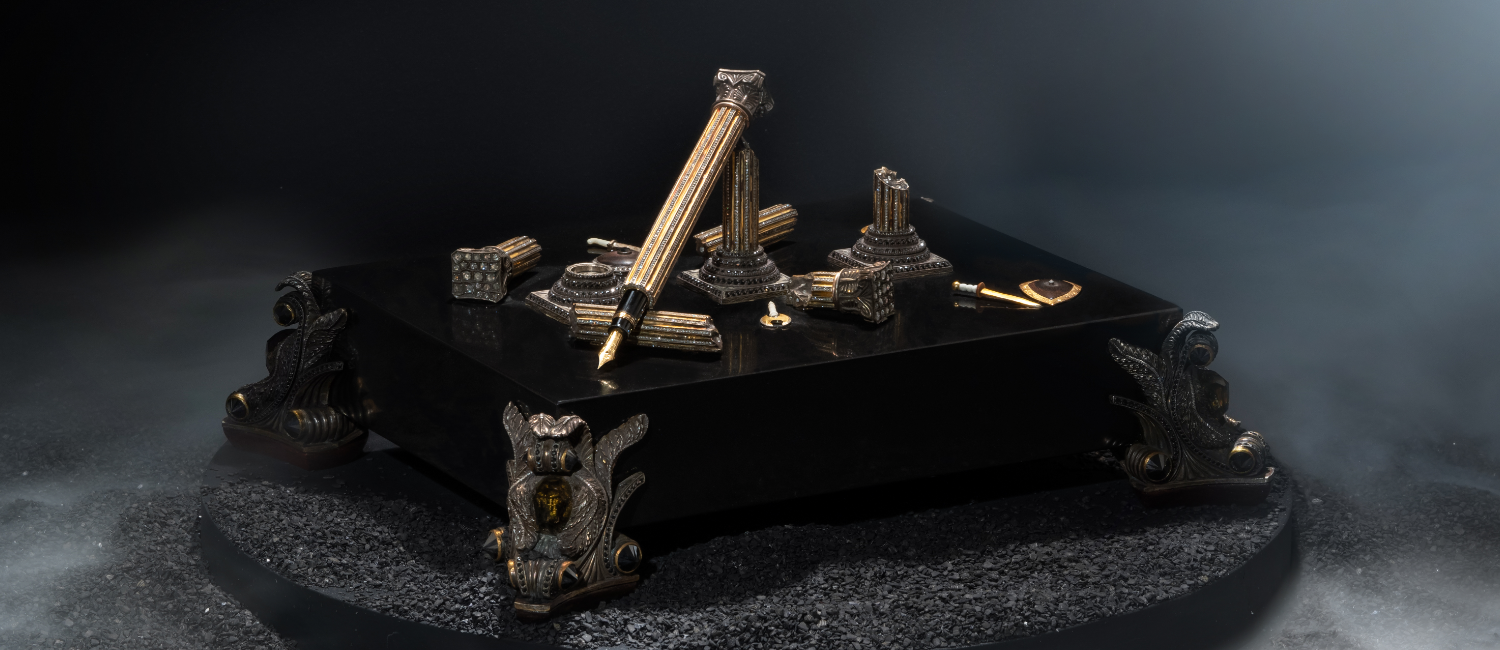
Fountain pen set of black marble, gold, silver and diamonds.
History has seen countless civilizations become victim to rebellion, war, and natural disaster. Some had ports destroyed as rivers brought soil and filled them up. Others found the strategic advantages garnered by their location destroyed by the discovery of new trade routes. Empty foundations and ruined columns are all that remained. In this piece shaped by Sevan Bıçakçı's hands, we see a temple destroyed by war. When you grab its last remaining column and pull it out, you find it's a fountain pen: A reminder that some things still last and stand tall.
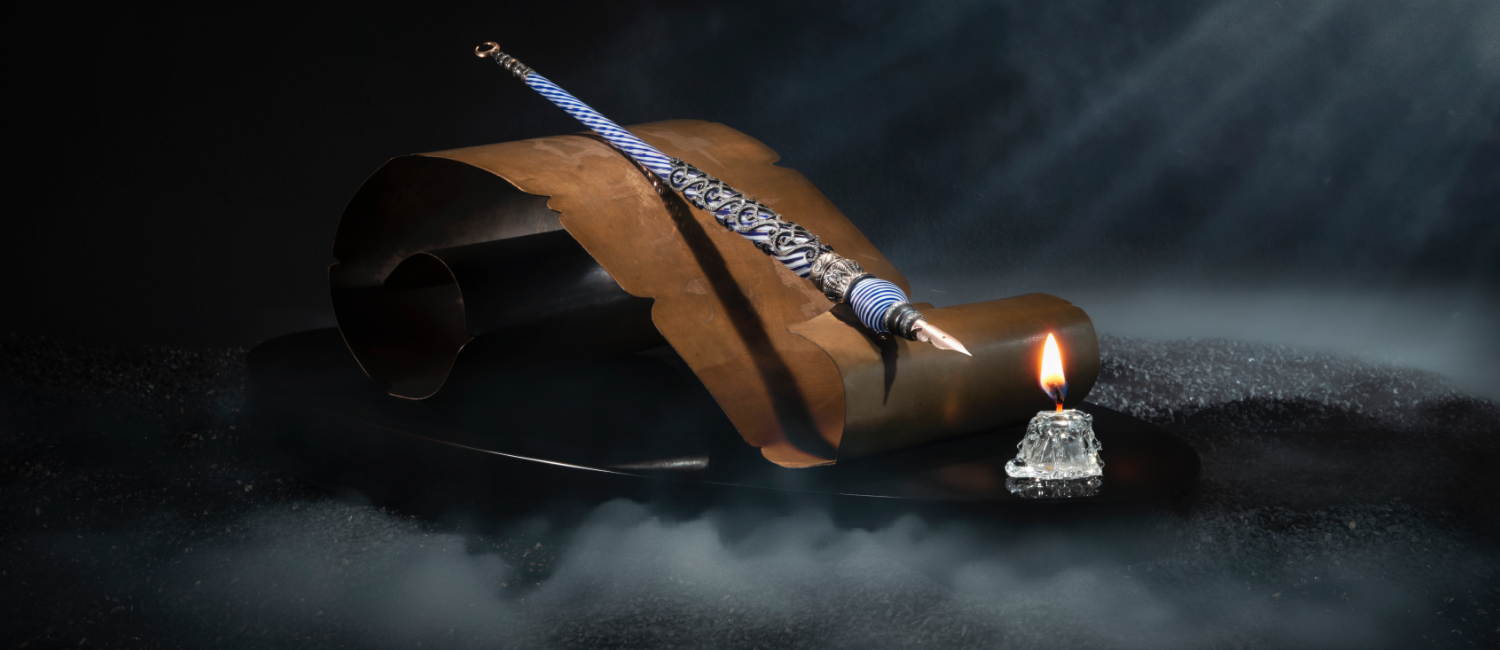
Dip pen set of black marble, glass, bronze, gold, silver and diamonds.
A Mevlevi dervish named Mehmed Dede was sent to Venice by the decree of Sultan Selim III (reign 1789 - 1807). There he learned the intricacies of glass blowing. When he returned to Istanbul, he developed a wholly unique style he called Çeşm-i Bülbül (The Nightingale's Eye) due to its resemblance of its namesake. Using this technique, he produce wonderful jugs, vases, bowls, and more. 200 years later, Sevan Bıçakçı has harnessed the philosophies of patience and dedication, central to all of his own work as well, and has put them to us in an object study by designing a Çeşm-i Bülbül pen, worthy of a decree by Sultan Selim III himself. He hopes it's worthy of Mehmed Dede's esteem as well.
Table clock of gold, silver, black and white marble, sandstone, diamonds, rubies and rock crystals with reversely engraved galleons.
Taqī al-Dīn Muhammad ibn Ma'ruf was the chief astronomer of the Ottoman Empire. Under the invitation of Sultan Murad III, he established the largest and most advanced observatory of his time on the hills of Istanbul's Tophane. Many of the instruments he used were of his own invention. He made use of trigonometry, astrolabe inherited from scientists throughout the Islamic world, and clocks with a second hand - a new invention in the era. He left behind inventions that advanced the fields of mathematics, astronomy and optometry. Unfortunately, the observatory he built lasted only for three years. Religious scholars of the period looked with suspicion upon astronomers of the period. They claimed that observatories would bring bad luck wherever they were established. Then a plague outbreak following a comet seen from the observatory gave them the opportunity they'd been seeking. In 1580, they reduced this magnificent work to cannon fodder, despite at its height being rivaled only by the observatory built by Tyco Brahe - Kepler's teacher. Sevan Bıçakçı doffs his cap to the genius of Taqī al-Dīn 500 years later.
 We use cookies.